LEAP: A Human Framework for Making Change Simple, Social and Sustainable

A practical model for leaders navigating transformation in organisations and institutions
Change is often treated as a technical challenge: design the strategy, communicate the plan and train people in the new way of working. Yet many transformations falter even when those elements are in place. The difficulty is not always that people lack information.
It’s that change alters meaning, identity, status, routines, relationships and the felt sense of belonging.
People are asked not only to do something differently, but often to become someone different in relation to their work, colleagues and institution.
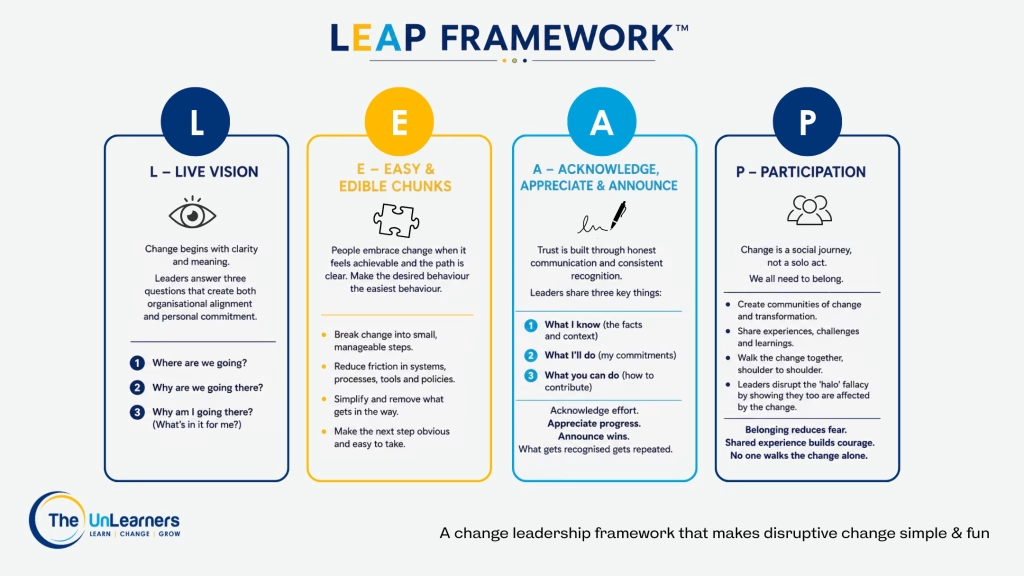
The LEAP Framework, developed by The UnLearners, responds to this human reality. It’s built around four conditions that make change more understandable, more doable (simpler), more socially sustainable and even fun: Live the Vision; Easy & Edible Chunks; Acknowledge, Appreciate & Announce; and Participation.
Together, these principles provide leaders with a practical way to translate large-scale ambition into everyday movement and momentum that reduces people drag and improves buy-in.
LEAP shifts change from an organisational event into a shared and owned journey.
L: Live Vision
Change begins with direction, but direction alone is insufficient. A vision becomes useful only when people can understand both its organisational logic and its personal relevance for them. The Live Vision principle therefore asks leaders to answer three questions clearly and repeatedly: Where are we going? Why are we going there? Why am I going there (what’s in it for me)?
The first question creates a picture of the destination. The second establishes the strategic, ethical or institutional case for movement. The third closes the gap between collective ambition and individual commitment. It recognises that employees, faculty members, managers, students or stakeholders do not experience change as an abstract system. They interpret it through questions of identity, opportunity, competence, security, contribution and loss.
For leaders, this means vision cannot be confined to a fancy launch presentation with unlimited pizza and fizzy drinks, as I’ve seen done. It must be lived through consistent decisions, resource allocation, language, rituals and behaviour.
When leaders say one thing but reward another, the organisation and its people follow the reward. Living the vision therefore requires visible alignment between the future being described and the present choices being made and executed on.
E: Easy & Edible Chunks
Large-scale change becomes overwhelming when it arrives as one undifferentiated demand that lands with a thump on peoples’ laps.
Easy & Edible Chunks is the discipline of reducing transformation into manageable steps while also redesigning the environment around those steps. It asks leaders to make progress psychologically manageable and operationally simple for an already overwhelmed workforce. No organisation we’ve support through change has been an exception to this.
This is not an argument for making change superficial, fluffy or rosey. It is an argument for sequencing complexity in a way that supports buy-in and habituation.
People need to know the next meaningful action, not carry the full weight of the entire transformation at once – doing so can backfire very quickly. Equally, leaders must identify and remove the friction embedded in systems, policies, tools, approvals, reporting lines and routines.
I can’t count the number of times I’ve advised how contradictory it is to ask people to adopt a new behaviour while the organisation continues to make the old behaviour faster, safer or more rewarded.
The central leadership question here, then, is not simply, “How do we motivate people to change?” it’s, “What is making this change unnecessarily difficult?” When the desired behaviour becomes easier to understand, access and repeat, momentum grows.
The good news is that small steps, lower friction and visible progress create the conditions for sustained adoption and honestly, which stakeholder in the organisation doesn’t want that?
A: Acknowledge, Appreciate & Announce
Change creates information gaps, and people (especially those already anxious) rarely leave those gaps empty. In the absence of trusted clear communication, these gaps fill with assumption, rumour and private interpretation.
During our diagnostics conversations with staff across the organisation before supporting change efforts, I’ve listened to rumours worthy of the highest-selling tabloids. Rumours I later discovered were untrue, but I had to admit were not unfounded. Why? They calcified in the absence of clear, ongoing, reliable information.
Acknowledge, Appreciate & Announce gives leaders a simple communication discipline built around three messages: what I know, what I will do and what you can do.
“What I know” requires honesty about the facts, including what remains uncertain. “What I will do” turns leadership communication into a commitment rather than mere commentary. It tells your people what support, decisions, advocacy or action they can expect from those with the authority. “What you can do” restores agency by clarifying the practical contribution available to them at their level within the organisation.
The principle also emphasises recognition and the pivotal role it plays in situations of uncertainty and strain. Leaders should acknowledge the effort and emotional labour involved in changing, appreciate progress before perfection, and announce milestones so that movement becomes visible to those who so deeply need to see it.
Recognition is not a decorative addition to change that makes it all look cute, it helps people see that their effort matters and that the new direction is becoming real. Ultimately from my experience, what’s noticed and observed (alongside reflection) is more likely to be repeated.
P: Participation
The final principle begins with a simple premise: change is social – all day, everyday. Human beings use the behaviour of others to judge what’s safe, accepted and possible. For this reason, lasting transformation cannot rely only on individual understanding. It needs to create communities of change in which our people can share experience, share the pain and uncertainty of transition, learn together and walk the journey shoulder to shoulder.
Participation is therefore more than consultation or what many of us are now calling ‘check-ins’ or ‘check-ups’. It’s the deliberate creation of spaces where people can influence the journey, experiment, offer feedback, make meaning and support one another in real time.
Belonging matters because changing one’s mind, role or identity can carry a heavy amount of social risk.
People are more willing to reconsider old assumptions when they know that doing so will not automatically cost them their place in the group of people they so deeply want to be part of (for their survival).
A critical part of this work is disrupting what’s known as the “halo fallacy”: the tendency for leaders to appear as though they stand above the disruption, fully certain and personally unaffected. This distance can unintentionally make team members feel that difficulty is a sign of weakness or incompetence. In reality, leaders are also deeply affected by change, although often in different ways. Their authority, expertise, routines, identity and assumptions are very often also challenged in ways they hadn’t previously imagined.
When leaders responsibly reveal how they are also learning, letting go and adapting, they humanise the transition without abandoning their responsibility to lead. They communicate, in effect, “I am not outside this change. I am walking through it differently, but I am walking through it too.” That honesty builds trust and gives others permission to engage change without pretending to be unaffected.
Why LEAP Matters
LEAP is useful because it integrates four dimensions that are often separated in change practice: strategic meaning, behavioural simplicity, trustworthy communication and social belonging. It recognises that transformation is neither purely structural nor purely psychological. Systems within an organisation shape behaviour, leaders influence meaning, and communities often dictate whether new behaviour is sustained.
For business leaders, the framework offers a practical test for whether a change effort is genuinely adoptable and will sustain. For academic and institutional leaders, it provides a lens through which to examine how people interpret and enact transformation across cultures, disciplines and communities.
In both contexts, it reframes resistance not as a defect for us to manage, but as information about where clarity, simplicity, trust or belonging may be missing or falling short.
People do not merely need a plan for change. They need a reason, a manageable path, trusted leadership and people with whom to walk.
The framework is ultimately an expression of The UnLearners’ vision: to build a world where it is okay to change your mind, and its mission: making change simple and fun. LEAP doesn’t make transformation effortless, it makes it more human, and therefore more possible.